
How Phenotype Matching Works in Clinical Genomics
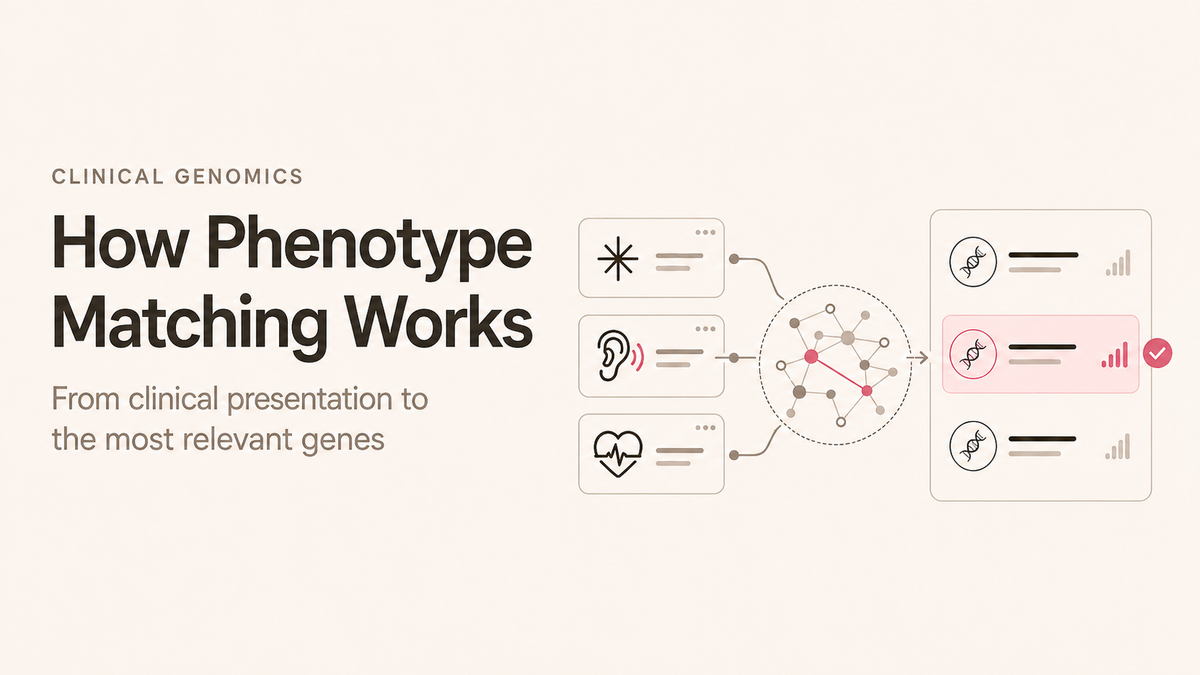
Finding the variants that fit the patient without confusing phenotype relevance with pathogenicity.
A genome can contain many variants that deserve attention. The clinical question is narrower: which of them fits this patient?
Phenotype matching helps answer that question. It compares the patient's observed features with phenotype knowledge linked to genes represented in the case. The result is a patient-specific view of the findings, instead of a generic list ordered only by predicted impact or pathogenicity.
A phenotype matcher has to understand meaning
An exact keyword match is too brittle for clinical genomics. One clinician may record a broad feature, while the available annotation uses a more specific related term. Different names can also describe closely connected parts of the same phenotype.
Folklore works with Human Phenotype Ontology (HPO) terms as connected clinical concepts. It considers where terms sit in the ontology and how informative they are. A specific feature can help distinguish between candidate genes; a very broad feature carries less discriminating information.
This allows the phenotype match to recognize clinically related terms without treating every relationship as equal. The output is a structured comparison, not a count of identical labels.
Start with a phenotype the clinician owns
Folklore accepts selected HPO terms and clinical notes for the case. HPO search and text extraction help turn the clinical description into structured terms. The final term set remains a clinical input: the geneticist decides what belongs in it.
That matters because phenotype matching cannot repair a weak case description. A broad or incomplete term set gives the system less information to distinguish between candidates. As the presentation becomes clearer, the phenotype can be updated and the matching repeated against the same case.
Compare the patient with the genes in the case
For each gene represented in the analysed findings, Folklore compares the patient's HPO terms with phenotype annotations linked to that gene. It identifies the closest supported relationships for each clinical feature and combines them into an overall view of fit.
The platform presents the result at gene level, with the underlying variant details available for review. The geneticist can see which patient features contributed and which gene-associated phenotypes were closest. A user can inspect why a gene moved up instead of accepting a single opaque number.
For laboratories working with panels, exomes, or whole genomes, this sits inside the same case workflow. The phenotype view appears beside classification, inheritance, frequency, and the other evidence attached to the variants. It does not require a separate spreadsheet or a detached research tool.
Phenotype relevance and pathogenicity are different questions
Pathogenicity asks whether the evidence supports a variant class. Phenotype relevance asks whether the finding fits the patient's presentation. Folklore keeps those decisions separate.
A high phenotype match does not turn a VUS into a pathogenic variant. It can place that VUS higher in the review order because the gene fits the case. A pathogenic or likely pathogenic variant with little relation to the referral phenotype remains important, but it is kept separate from findings that better explain the patient.
This prevents a common interpretive shortcut: treating "pathogenic somewhere" as "causal here." The ACMG class remains the class. Phenotype matching changes the order in which the case is reviewed, not the underlying classification.
What a useful result should show
A useful phenotype matcher should return more than a rank. Folklore retains the contributing patient terms, their closest gene-associated matches, and the relationship between phenotype relevance and the rest of the variant evidence.
The output helps the geneticist ask practical questions. Do several of the patient's features point to the same gene? Does a result depend on one broad term? Is a pathogenic finding unrelated to the referral reason? Is a VUS worth a closer literature or family review?
No phenotype score can answer those questions alone. The value lies in putting the clinical presentation next to the genomic evidence and preserving enough detail for a qualified reviewer to disagree.
The limits are part of the result
Phenotype matching reflects the recorded features and the knowledge available at the time of analysis. Missing features, very broad terms, age-dependent presentation, and incomplete gene-disease knowledge can all change the ranking.
It supports case review. It does not replace segregation analysis, inheritance assessment, variant classification, literature review, or clinical judgment. The strongest phenotype match is still a reason to inspect the evidence, not a diagnosis.
Phenotype matching in Folklore
Folklore integrates phenotype matching with variant annotation and classification, family analysis, literature evidence, and clinical reporting. Laboratories can move from a case phenotype to a focused set of findings without losing the distinction between relevance and pathogenicity.
Use phenotype matching in the Folklore workflow
Review phenotype relevance beside classification, inheritance, and the rest of the case evidence.
The rules assign the class. Phenotype matching orders the case. The geneticist makes the final decision.