
Where the Human Gate Belongs: Deterministic Classification and Evidence Admissibility
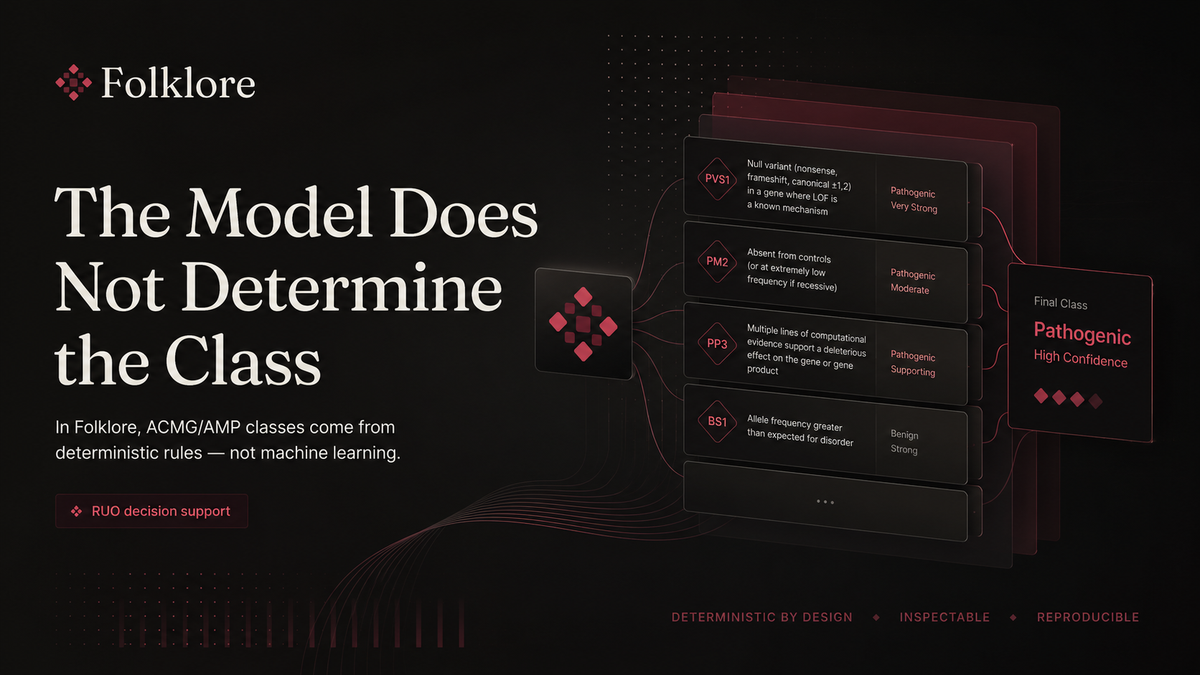
Why Folklore keeps AI out of variant classification and places human judgment where evidence enters the classifier.
In Folklore, variant classification happens before the AI layer is allowed to write anything.
The platform assigns one of the five ACMG/AMP classes: Pathogenic, Likely Pathogenic, Variant of Uncertain Significance, Likely Benign, or Benign. Depending on the variant type, it applies one of three published frameworks:
- the ACMG/AMP guidelines for nuclear variants;
- the MMDWG specifications for mitochondrial variants;
- the Riggs framework for structural and copy-number variants.
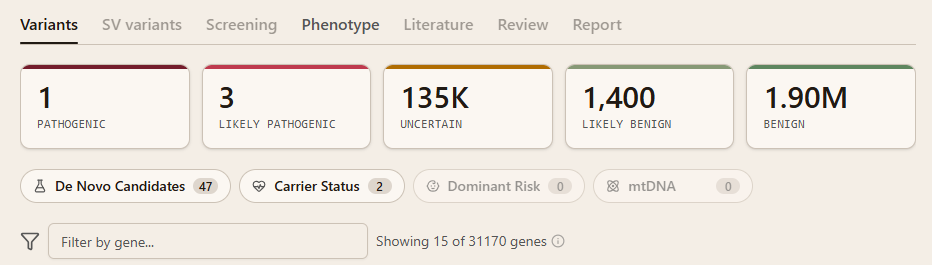
The resulting class is produced by rule-based combination code. It does not come from a language model.
For a fixed software version, reference-data snapshot, and recorded case input, the criterion path can be reconstructed: which evidence was available, which criteria were activated, and how those criteria produced the final class.
That boundary matters because computational evidence is not all of one kind.
Where machine learning enters
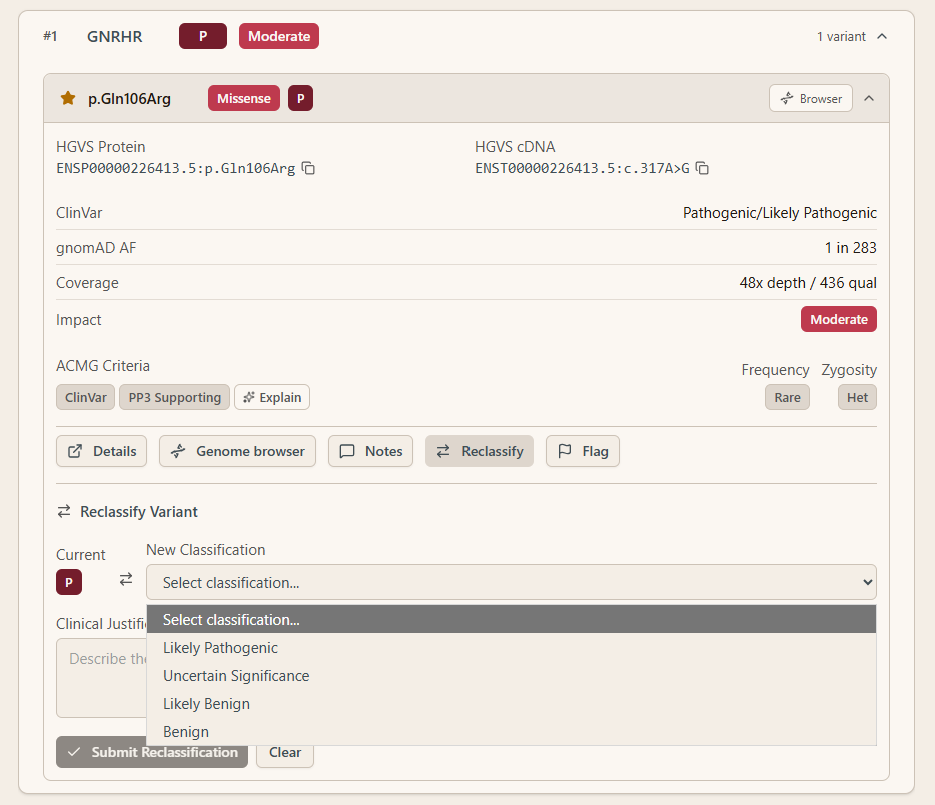
Some ACMG/AMP criteria are computational by design. PP3 and BP4, for example, use in-silico predictors to assess whether a variant may affect a gene or gene product. Several established predictors rely on machine-learning methods.
Folklore can use these scores, but it does not ask a live model to interpret the case and decide the class. Predictor outputs are treated as structured evidence. Their versions and thresholds are defined before the case is classified, and they contribute only through the relevant criterion.
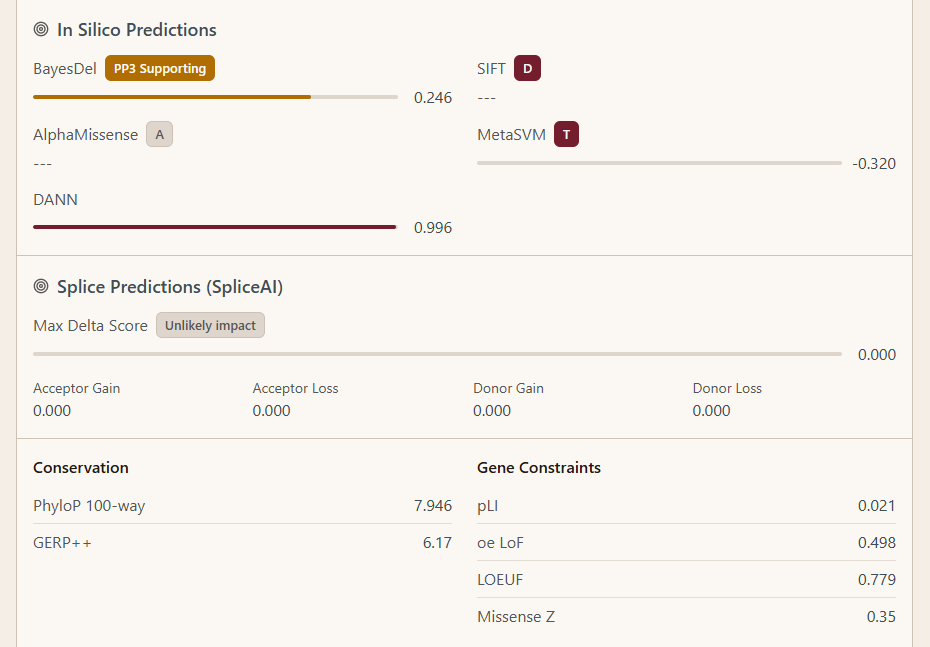
A computational predictor may therefore influence one part of the evidence record. It does not choose the final class.
The distinction is easier to see with an example. A calibrated predictor score may support PP3. The classification rules then combine PP3 with the other admitted criteria according to the applicable framework. The predictor does not decide how persuasive a functional study is, whether a family history establishes segregation, or whether a reported de novo occurrence is sufficiently supported.
Those decisions require a different kind of judgment.
The AI layer starts after classification
Folklore also includes an AI interpretation layer.
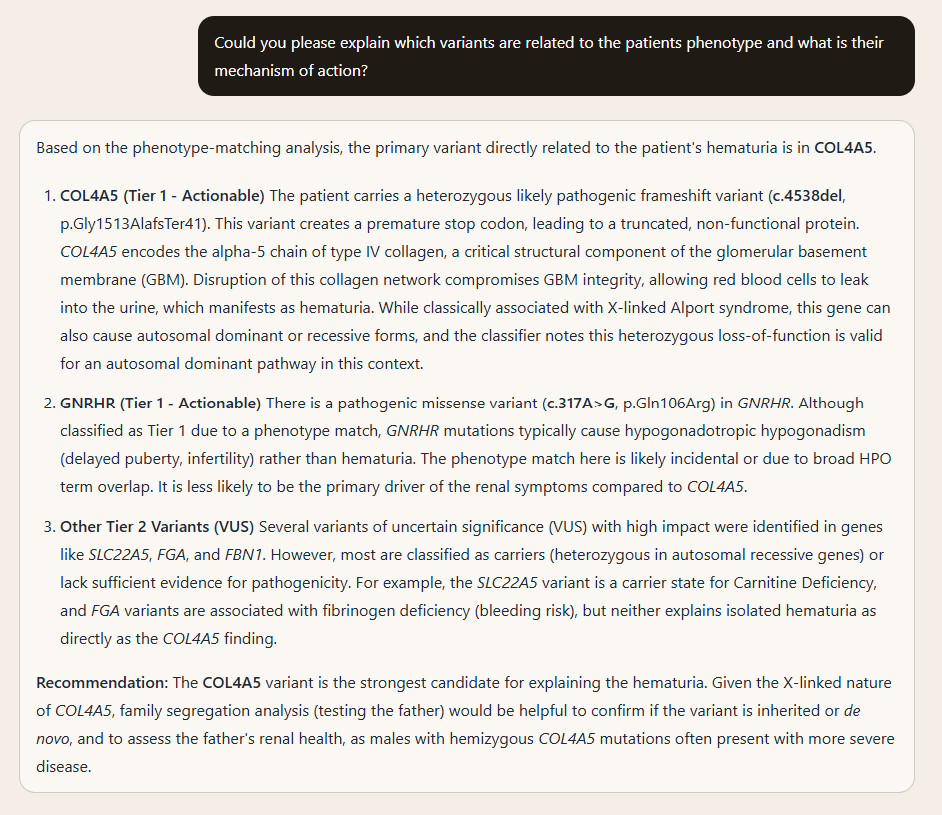
Once the deterministic classifier has produced a class and criterion path, the AI layer can examine the result, compare it with the wider case context, flag a possible disagreement, and help draft the report.
It can read the class. It cannot rewrite it.
A disagreement flag sends the case to human attention. It does not add a criterion, change its strength, or alter the combination rules.
This separation does not make the interpretation layer harmless or infallible. A generated explanation can still frame a finding poorly, omit something relevant, or place too much emphasis on one part of the result. Its output must be reviewed. The important architectural limit is narrower: model-generated text does not enter the class-determining path.
Some evidence cannot be reduced to a database field
Much of variant classification can be computed from structured data.
Population frequencies can be compared with defined thresholds. Previously established annotations can be retrieved. Allelic observations can be evaluated under explicit rules. Precomputed predictor scores can be mapped to computational criteria.
Other evidence does not arrive in that form.
Consider PS3, which concerns well-established functional studies. A paper may describe an assay, but the presence of a result in a publication is not enough. Someone must judge whether the assay is appropriate for the gene, whether its controls are adequate, and whether the experiment supports the claimed effect.
The same problem appears with segregation evidence under PP1 and with de novo evidence under PS2 or PM6. A pedigree, laboratory report, or publication can contain relevant information without settling whether the criterion should be applied or at what strength.
A language model can summarize these materials. It can point to passages that deserve review. The harder step is deciding whether the evidence is admissible for classification.
Folklore routes that decision to a person.
What determinism does and does not provide
A deterministic classifier is not automatically a correct classifier.
It can contain a software defect. Its reference data can be incomplete. A threshold can be poorly chosen. Human-admitted evidence can also be wrong. Determinism does not establish clinical validity or fitness for purpose.
It does make the class-producing mechanism easier to inspect.
A rule path can be read from input to result. The reviewer can identify the criterion, the relevant threshold, and the combination rule that affected the class. A model’s internal computation cannot be inspected in the same direct, rule-by-rule form.
The explanation is also tied more closely to the mechanism. When deterministic code records that a criterion fired because a value crossed a defined threshold, that record describes the operation that produced the result. A generated explanation may sound plausible without faithfully representing the internal computation that led to its output.
Folklore also keeps live generative-model inference outside the classification loop. This removes model-runtime variation from that specific path. Reproducibility still depends on controlled software versions, dependencies, data snapshots, recorded inputs, and tested execution environments; it should not be assumed merely because the code is described as deterministic.
The cost is less automation
This design leaves some work with the human reviewer.
A system that allows a language model to read publications and apply literature-dependent criteria can automate more of the classification process. Folklore does not allow model output to enter that part of the classifier.
As a result, some variants remain incomplete until a qualified person reviews the evidence. Functional studies, segregation records, and case-specific observations may require manual assessment and documented admission.
That costs time. It also makes responsibility easier to locate.
The reviewer is not asked to approve a class whose evidentiary history is hidden inside a model-generated judgment. The reviewer decides whether the evidence is suitable for classification, and the system records how the admitted criteria were combined.
Folklore is Research Use Only decision support and is not a CE-marked in vitro diagnostic device. Its output is advisory and must be reviewed and confirmed by a qualified professional.
The operating boundary is simple: the rules produce the class, the AI layer helps examine and explain the result, and a person admits the evidence that requires professional judgment.
The human gate belongs upstream, where evidence enters the classifier.